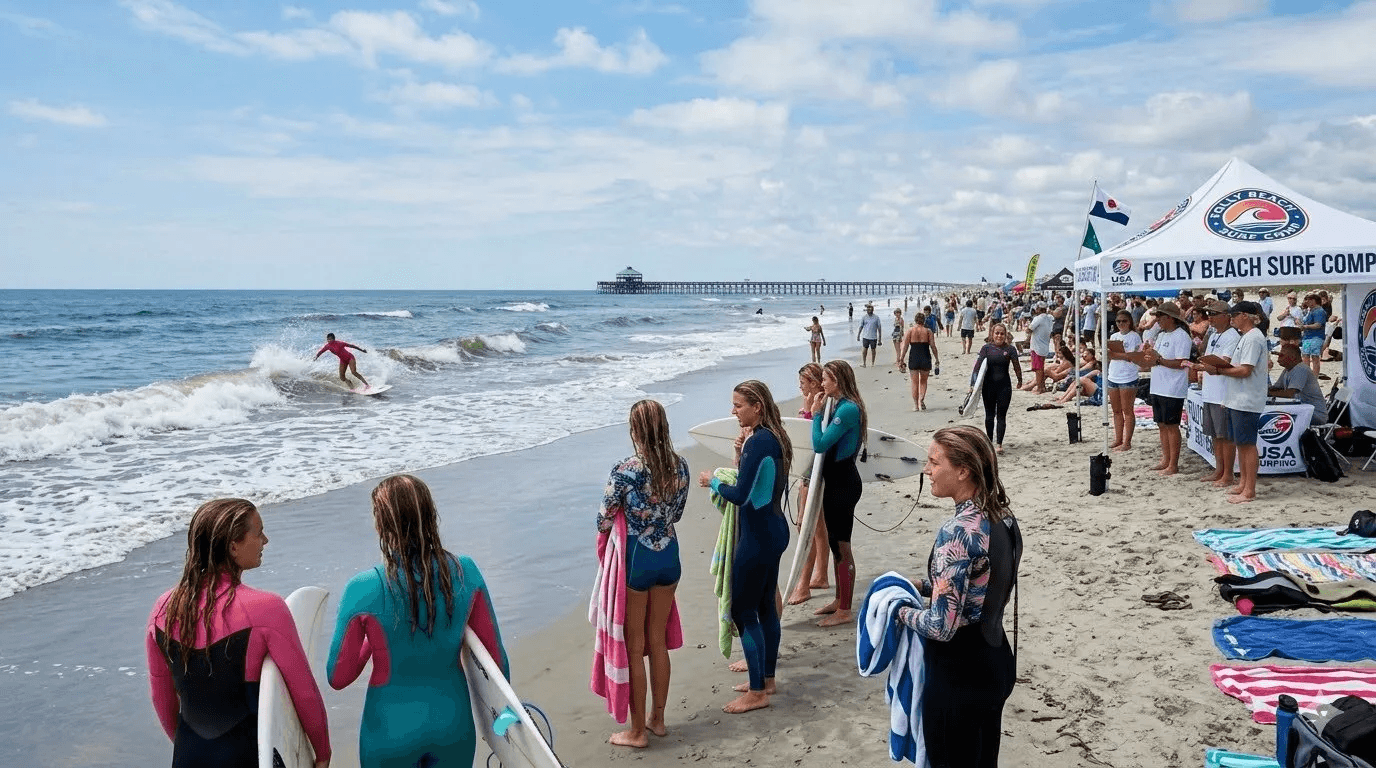
For eleven years, Folly Beach hosted one of the most beloved women's surf competitions on the East Coast. The Folly Beach Wahine Classic ran from 2006 to 2017, drawing competitors from up and down the Atlantic seaboard to the same stretch of beach every summer. It wasn't the biggest contest in women's surfing. It didn't need to be. What it was — and what made it matter — was local, women-first, and genuinely Folly.
This is the complete history of the Wahine Classic: how it started, what it became, and why it still defines this beach's identity more than any event before or since.
What "Wahine" Means
Wahine is a Hawaiian and Māori word for woman. In surf culture, it's been used for decades to refer to female surfers — a term of respect that carries the water with it. When the founders named the competition, they weren't going for clever branding. They were stating plainly what the event was: a celebration of women in the water, on their terms.
At the time, women's surfing on the East Coast existed largely at the margins of a surf scene that was still predominantly male. Local competitions featured women's divisions, sometimes. Events designed specifically for women surfers were rare. The Wahine Classic was an attempt to change that on Folly Beach — and it worked.
How It Started
The first Folly Beach Wahine Classic ran in 2006. The competition was organized by local surf community members who wanted to create a dedicated space for women's surfing on the island. Folly Beach was — and remains — the premier surf destination in South Carolina. The Washout, the beach's signature break created by Hurricane Hugo in 1989, had been drawing surfers for nearly two decades by then. The Pierre Moran Pier area offered a different kind of wave. The island had the surf. It just needed an event that put women at the center of it.
That first year set the template that would carry through the next decade: a weekend competition, multiple divisions organized by age and skill level, and a community atmosphere that felt less like a contest and more like a gathering. Spectators lined the beach. Local businesses sponsored it. The crowd knew the competitors by name.
The Competition Format
The Wahine Classic ran divisions across the full spectrum of women's surfing. Longboard and shortboard divisions gave competitors a choice of craft. Age brackets ranged from groms — girls as young as eight or ten competing in their first contest — through masters divisions for experienced women who'd been surfing Folly for years. The standup paddleboard division reflected the growth of SUP as a discipline during the late 2000s and early 2010s.
Judging followed standard surf competition criteria: wave selection, commitment, degree of difficulty, combination of maneuvers, speed, power, and flow. But the scoring almost felt secondary to what was happening on the beach. This was a contest where a twelve-year-old catching her first competition wave got the same roar from the crowd as a twenty-five-year-old executing a clean cutback.
Its Place in Folly Beach Culture
By the time the Wahine Classic reached its peak years in the early 2010s, it had become one of the signature events on the Folly Beach calendar. The competition drew surfers from across the Southeast — Georgia, North Carolina, Virginia, Florida — and gave the island a moment each summer that belonged entirely to the local surf community.
For Folly Beach, an island that has always resisted the resort-ification that consumed other South Carolina beaches, the Wahine Classic fit perfectly. This was not a corporate-sponsored spectacle. It was people who loved this beach, putting together something worth showing up for.
The Surfer Magazine feature on the 2006 competition — which brought national attention to both the event and Folly Beach — captured something essential about what made it work. The photographs showed women of all ages in the water together, the pier visible in the background, the Atlantic doing what it does on a summer morning. It looked like Folly Beach. It looked like surfing. It looked like exactly what it was.
The Final Years and Legacy
The Wahine Classic ran its last official competition in 2017. Eleven editions. More than a decade of women surfing Folly Beach in front of a crowd that came specifically to watch them do it.
The reasons events like this end are usually the same: organizing fatigue, sponsorship changes, the weight of making something happen year after year with a small team. The Wahine Classic was a volunteer-driven labor of love from the beginning. That it lasted as long as it did says everything about how much it mattered to the people who built it.
What it left behind is harder to quantify but easy to see. Women's surfing on Folly Beach didn't stop when the competition did. The generations of girls who grew up competing in the Wahine Classic — who got their first taste of surf competition at this event, who developed their surfing with the Wahine Classic as a goal each summer — are still out there. Some of them are among the better surfers on the island today.
The Washout and the Wahine Classic's Waves
A word on the surf itself, because the Wahine Classic wasn't held at a random stretch of beach.
The competition ran near the Folly Beach Pier — the Edwin S. Taylor Fishing Pier — which creates a predictable break that's accessible to a range of skill levels. Surfing is still regulated within 300 feet of the pier year-round, a rule that keeps the break safe for both competitors and recreational swimmers. The Washout, located further down the island, is Folly's more powerful break and the one that draws experienced surfers year-round — for a full breakdown of swell, conditions, and technique at each spot, see the Folly Beach surfing guide. The pier area offered contest conditions that worked for the full range of Wahine Classic divisions, from beginners to advanced competitors.
Folly Beach waves are Atlantic beach break — not the hollow barrels of the Pacific coast, but real waves with real power when conditions align. An east or northeast groundswell with light offshore winds produces the kind of surf that the Wahine Classic was built around: rides long enough to execute maneuvers, waves consistent enough to run heats cleanly.
Where the Name Lives On
This website carries the Wahine Classic's name forward. Follybeachwahine.com was the official home of the competition from 2006 through 2017. When the competition ended, the domain went dark. We brought it back because the name belongs to Folly Beach — and because the story of the Wahine Classic is worth telling to every person who discovers this island for the first time and wants to understand what makes it different.
The Wahine Classic was eleven years of proof that Folly Beach surf culture is broad enough and deep enough to support a dedicated women's competition — and that when you build something real, people show up for it.
That's the kind of place this is. That's what we're here to document. If you're visiting Folly Beach for the first time, everything worth doing on the island extends well beyond the surf — but the surf is always a good place to start.