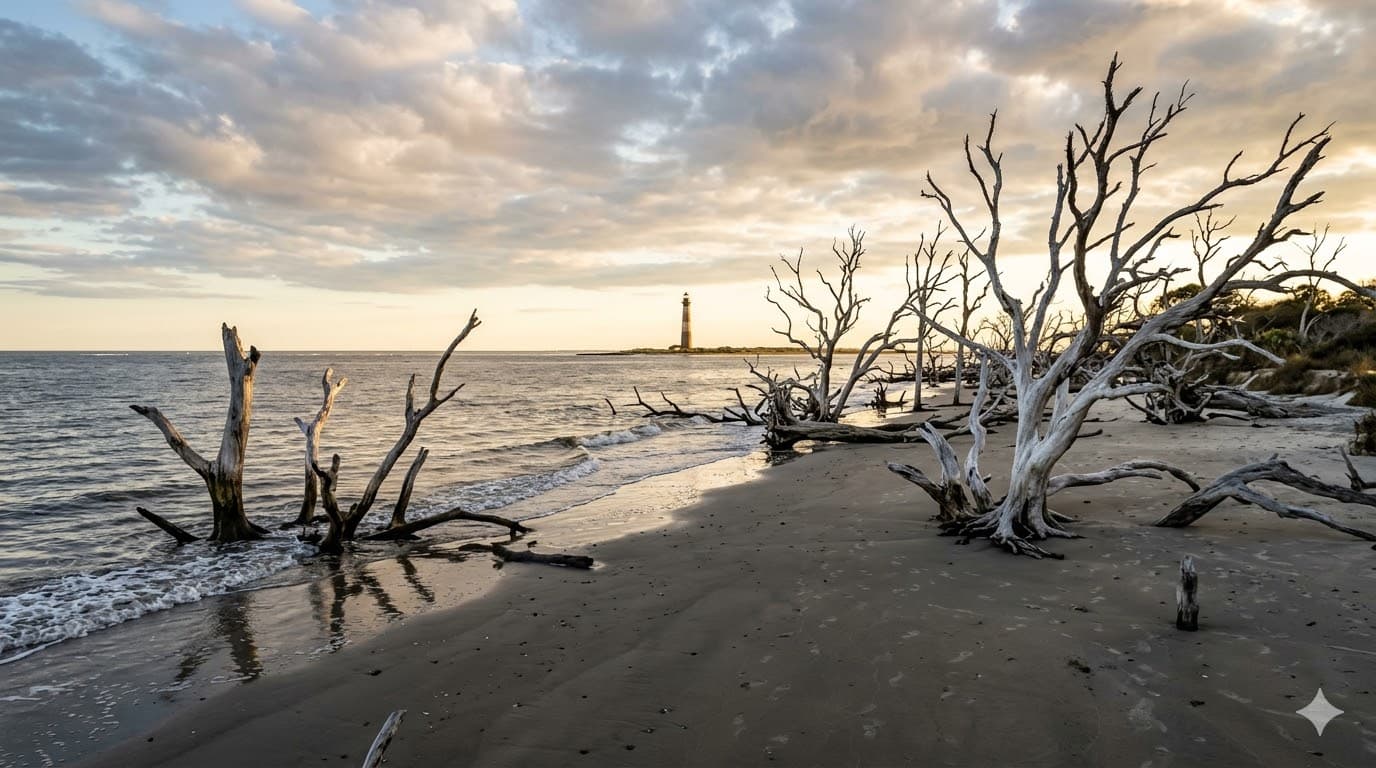
At the eastern tip of Folly Island, where the beach meets Lighthouse Inlet, there is a stretch of coast unlike anything else in the Charleston area. Ancient trees — oak, cedar, and palmetto — stand dead in the surf and on the beach, their trunks bleached white by salt and sun, their root systems exposed by decades of erosion. This is Boneyard Beach, and it is one of the most photographed and least understood spots on the South Carolina coast.
What Boneyard Beach Actually Is
Boneyard Beach is not a named park or an official destination. It's a stretch of shoreline at the far eastern end of Folly Island — specifically within and adjacent to the Lighthouse Inlet Heritage Preserve — where coastal erosion has killed trees that once stood well inland and left their remains on the beach.
The erosion here is dramatic and ongoing. The Charleston Harbor jetties, built in the late 1800s to maintain the shipping channel, fundamentally altered sediment transport along this section of coast. The result has been significant erosion at the eastern end of Folly Island for over a century. Trees that were part of the island's interior forest have been gradually claimed by the sea as the beach has moved landward around them.
What's left is visually striking — stark white trunks and twisted root structures against the sand and water, with the Morris Island Lighthouse visible across the inlet. It looks like a set from a film. It's entirely natural.
How to Get There
Getting to Boneyard Beach requires a walk. It is not accessible by vehicle and there is no dedicated parking lot for it.
The most direct approach is from the eastern end of East Ashley Avenue. Park at the end of the road — there is limited street parking — and walk toward the inlet. You'll pass through the Lighthouse Inlet Heritage Preserve, which is also the best area for shark tooth hunting. Continue east along the beach toward the inlet and you'll reach the boneyard trees.
The walk from the end of East Ashley Avenue to the main concentration of dead trees takes roughly 15-20 minutes on foot along the beach. The terrain is flat and the walking is easy in dry conditions. At higher tides, parts of the path can be wet — wear shoes you don't mind getting sandy and possibly damp.
The distance from Center Street to the boneyard trees is significant — about 1.5 miles east along the beach. Some visitors choose to bike partway and walk the beach section. Others walk the full distance. It's worth the trip either way.
When to Go
Sunrise and sunset are the best times to visit Boneyard Beach. The low angle light turns the bleached white trunks golden and creates dramatic shadows across the sand. Photographers specifically time visits around sunrise for this reason.
Low tide is preferable to high tide. At low tide more of the root systems and lower trunks are exposed, the beach is wider, and the visual impact of the trees standing in and around the water is at its best. At high tide, the water can reach the base of the trees and some areas become difficult to navigate.
Weekday mornings give you the best chance of having the beach largely to yourself. Boneyard Beach is popular with photographers and Instagram visitors, and weekend afternoons can draw surprising crowds given the walk required to reach it.
Year-round — Boneyard Beach is worth visiting in any season. Winter visits have the advantage of very few other people, dramatic skies, and the stark quality of the dead trees against a gray Atlantic that looks completely different from the summer version.
Photography
Boneyard Beach is one of the best photography locations in the Charleston area. The combination of the dead trees, the inlet water, the Morris Island Lighthouse in the background, and the quality of light at golden hour creates conditions that are hard to replicate elsewhere.
A few practical notes for photographers: the wide open beach means no shade, so morning and late afternoon visits are significantly more comfortable than midday in summer. The sand reflects light intensely on bright days, which can blow out exposures — shooting with the sun at an angle rather than overhead helps. The lighthouse in the background is roughly 1,500 feet away and requires a moderate telephoto lens to bring it into compositional relationship with the foreground trees.
What You'll Actually See
The trees at Boneyard Beach are in various stages of decay. Some are still largely intact — full trunks standing in the surf with their root systems visible at the base. Others have fallen and lie across the beach in sculptural tangles of bleached wood. The concentration of trees grows as you move toward the inlet, with the densest section closest to the water.
The beach here is also a productive area for shell collecting and, as noted, shark tooth hunting. The same sediment dynamics that are eroding the island and killing the trees also concentrate fossils on this section of beach. If you're walking to the boneyard, bring a bag — you'll likely find things worth keeping along the way.
The Morris Island Lighthouse view is a constant presence on this section of beach. The lighthouse sits roughly 1,500 feet offshore and was decommissioned in 1962. Its isolation in the middle of the inlet — unreachable except by boat — gives it a quality that's hard to see from anywhere else on Folly Beach. The boneyard trees in the foreground with the lighthouse in the background is the signature composition of the eastern end of the island.
Combining with Other Activities
Boneyard Beach is at the same end of the island as the Lighthouse Inlet Heritage Preserve and the shark tooth hunting areas. The walk to the boneyard passes through the preserve, so combining the two activities in a single visit makes practical sense — walk out to the boneyard trees and hunt for shark teeth on the way back.
For the full eastern end experience: arrive at low tide in the morning, spend an hour at the boneyard, work back through the preserve hunting teeth, and finish with breakfast at Lost Dog Cafe or coffee at Center Street Coffee before the midday heat sets in.
See our shark tooth hunting guide for everything you need to know about finding teeth on this stretch of beach, and our complete things to do guide for everything else the island offers.