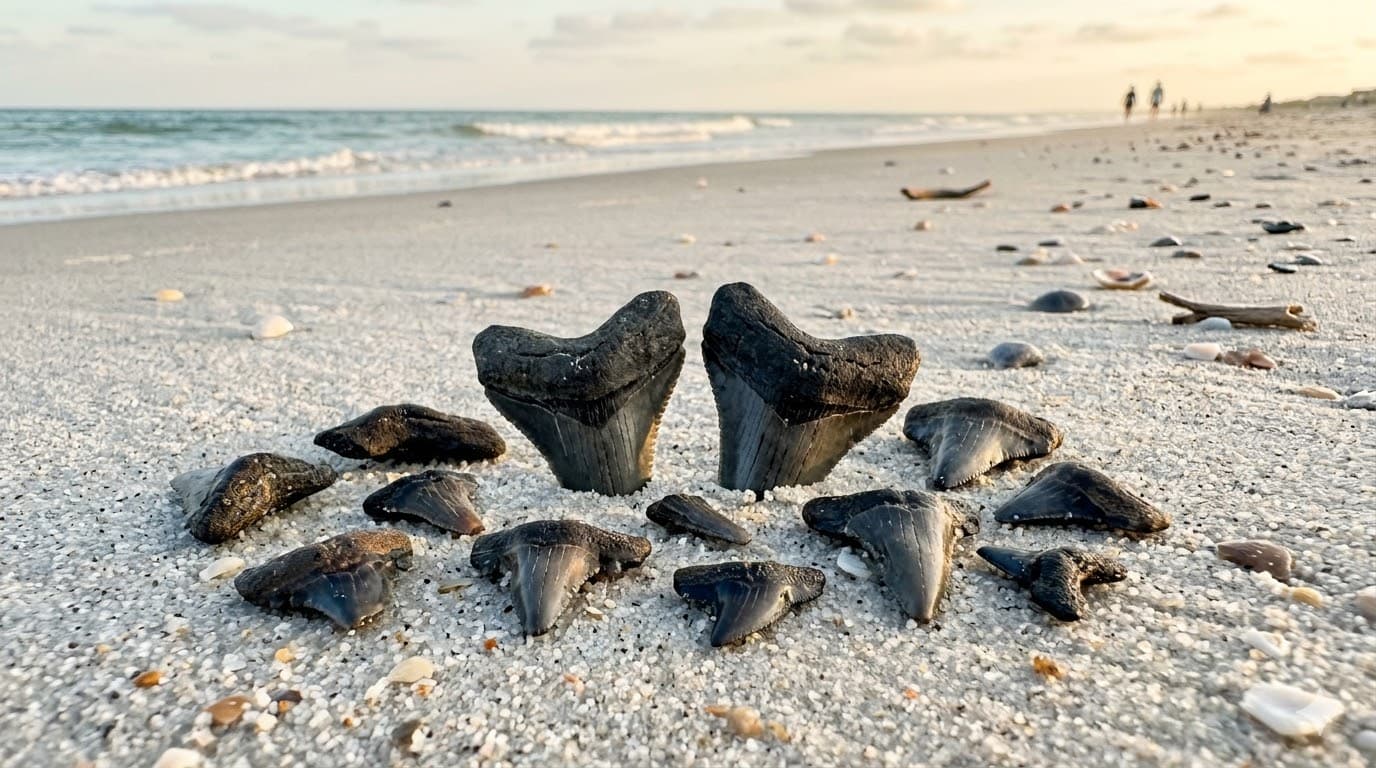
Folly Beach sits at the edge of one of the most fossil-rich stretches of coastline on the East Coast. The waters off South Carolina contain an abundance of fossilized shark teeth — including megalodon teeth from a species that went extinct roughly 3.6 million years ago — and Folly Beach is one of the best places to find them washing ashore. You don't need special equipment. You don't need to dive. You just need to know where to look and what to look for.
Why Folly Beach Has So Many Shark Teeth
The South Carolina coast sits on top of sedimentary deposits that were once shallow ocean floor. Millions of years ago, the waters that covered this region were home to enormous populations of sharks — including Otodus megalodon, the largest shark species ever documented. Sharks continuously shed and replace their teeth throughout their lives, depositing them in sediment on the ocean floor over millions of years.
As the coastline erodes and tidal currents move sediment, those fossilized teeth work their way to the surface and wash onto beaches. The combination of Folly Beach's geography, the tidal patterns created by the nearby Charleston Harbor jetties, and the proximity to Lighthouse Inlet makes the eastern end of the island particularly productive for shark tooth hunters.
The Best Spot — Lighthouse Inlet Heritage Preserve
The single best place to find shark teeth at Folly Beach is the Lighthouse Inlet Heritage Preserve, located at the far eastern end of the island. The preserve is accessed from the end of East Ashley Avenue — park at the end of the road and walk toward the inlet.
The preserve sits at the confluence of the Atlantic Ocean and Lighthouse Inlet, directly across from Morris Island. The tidal currents through the inlet concentrate sediment — and the fossils it contains — on the beaches of the preserve. The combination of active erosion, strong tidal flow, and the geological history of this section of coast makes it the most consistent shark tooth hunting location in the Charleston area.
The terrain at the preserve changes with tide and season. At low tide the sandbars in the inlet expose areas that are completely underwater at high tide — these exposed bars are some of the best hunting grounds. Timing your visit around low tide is the single most effective thing you can do to maximize your finds.
What to Look For
Fossilized shark teeth are typically dark — black, dark gray, or dark brown — because the fossilization process replaces the original tooth material with minerals from the surrounding sediment over millions of years. This is what distinguishes them from modern shark teeth, which are white or off-white.
Size range: Most teeth you'll find at Folly Beach are small — between a quarter inch and an inch. These belong to species like bull sharks, tiger sharks, and various smaller prehistoric sharks. Finding a tooth over two inches is a genuinely exciting find. Megalodon teeth, which can exceed four inches and occasionally larger, are rare but documented at this location.
Shape: Shark teeth have a distinctive triangular shape with serrated edges on many species. Once you've found your first one, your eye calibrates quickly — you'll start seeing them in ways you walked past before.
Where to look on the beach: The best hunting is at the waterline, where waves are actively depositing material from offshore. The swash zone — the area where waves are washing up and receding — turns over sediment with each wave. Work slowly through this zone, keeping your eyes on the sand as water recedes. Dark triangular shapes against lighter sand are what you're scanning for.
Black sand concentrations are a good sign. When you see patches of dark sand mixed with shell fragments, slow down and look carefully — the same processes that concentrate dark mineral sand also concentrate fossilized teeth.
The Best Conditions for Hunting
Tide: Low tide is significantly better than high tide. The lower the tide, the more beach and sandbar is exposed, and the more fresh sediment has been deposited by the receding water. Check the tide chart before you go and plan to arrive as the tide is going out.
After storms: Rough water and strong surf stir up sediment from offshore, depositing material on the beach that wasn't there before. The day after a storm, particularly one with northeast winds and onshore swell, is often the most productive day for shark tooth hunting. The beach looks messier — more shell hash and debris — but that debris frequently includes teeth that were sitting offshore the day before.
Morning: Getting to the preserve early means your eyes are the first ones over that section of beach. Popular spots get picked over quickly on summer weekends. An early morning low tide after a storm is the optimal combination.
Season: Hunting is possible year-round at Folly Beach. Winter can actually be productive because the beach sees fewer visitors and storms are more frequent, depositing material regularly. Summer brings more hunting competition but also more tidal activity.
Equipment
You don't need much. A mesh bag or container for your finds. A small sifter or mesh scoop can help if you want to work through shell hash more systematically — rake shell material into it and let sand fall through, looking at what remains. A sun hat and water are practical necessities on a summer day.
Some serious tooth hunters use snorkeling equipment to look for teeth in shallow water — the bottom just offshore at low tide can be productive. This requires more experience and comfort in the water but can yield larger finds than beach hunting alone.
Morris Island and the Lighthouse View
The preserve also gives you the closest accessible view of Morris Island Lighthouse — the decommissioned 1876 lighthouse that stands roughly 1,500 feet offshore in the inlet. At very low tide the sandbar between the preserve and the lighthouse partially exposes, and some hunters walk partway out toward it. If you attempt this, turn back well before the tide comes in — the current in Lighthouse Inlet is strong and conditions can change faster than they look from the beach.
The lighthouse view combined with the shark tooth hunting makes the preserve one of the more genuinely interesting beach experiences accessible from Folly Beach — it's not just another stretch of sand.
What to Do With What You Find
Most finds are small teeth that fit easily in a pocket. Rinse them with fresh water when you get back and let them dry — they keep indefinitely. Larger teeth are worth preserving properly: a light coat of clear sealant helps protect the fossilization and keeps them from drying out and potentially cracking.
Megalodon teeth and other significant finds are legal to keep on South Carolina beaches. The preserve itself is a heritage preserve — check current regulations before removing significant geological specimens, though standard beachcombing and taking teeth you find on the surface is generally permitted.
For more on what to do while you're at this end of the island, see our guide to Folly Beach County Park — it's a short walk away and worth combining with a shark tooth hunting session. Our complete things to do guide covers everything else the island offers.