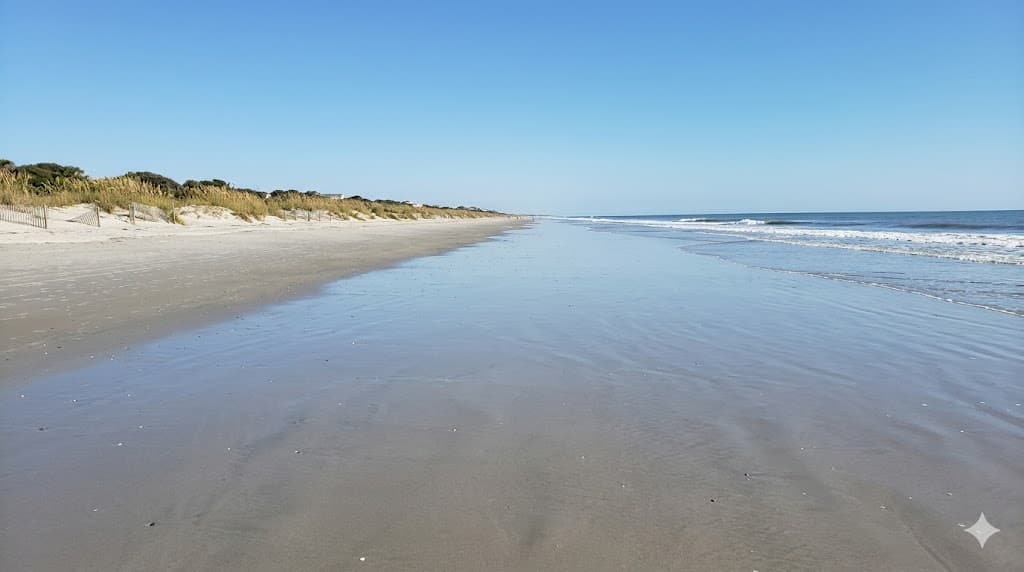
Tides run everything on Folly Beach. The difference between high tide and low tide determines where you can walk, how the waves break, whether the tidal creeks are navigable, and how productive a morning of shark tooth hunting will be. Understanding tides before you arrive makes your time on the island significantly better.
How Tides Work on Folly Beach
Folly Beach experiences semidiurnal tides — two high tides and two low tides each day. The tidal range on Folly Beach averages around 5-6 feet, which is substantial. A 5-foot tide change over the course of six hours visibly transforms the beach — at low tide, wide flat sand extends far from the dune line, while at high tide the water can reach close to the dunes themselves.
Tide times shift approximately 50 minutes later each day. If high tide is at 8 AM today, it will be around 8:50 AM tomorrow. This progressive shift means the same beach activity at the same time of day will encounter different tidal conditions depending on when during the tidal cycle you arrive.
Where to Find Current Tide Times
NOAA's Tides and Currents website (tidesandcurrents.noaa.gov) is the most accurate source for Folly Beach tide predictions. Use the Charleston, SC station — it's the nearest official station and its predictions are accurate for Folly Beach with minimal offset.
Surf forecast apps including Surfline, Magic Seaweed, and Windguru all display tide information alongside wave and wind data. If you're checking surf conditions, the tide is in the same interface.
The Folly Beach Wahine site will have a live tide chart tool available soon — check back for real-time conditions.
How Tides Affect Different Activities
Surfing: Most breaks on Folly Beach surf better on lower to mid tides. At high tide, water depth over the sandbars reduces wave quality — waves have less bottom to interact with and tend to be slower and less defined. At low tide the sandbars are shallower, waves feel the bottom sooner, and the break is typically more defined and powerful.
The Washout specifically tends to produce better surf on mid to low tide. Check the tide chart when you check the swell forecast. A good swell at high tide may be mediocre — the same swell three hours later at mid tide can be significantly better. See our Washout guide for more on reading conditions at Folly's best break.
Swimming: High tide brings the water closer to the dunes and reduces the width of the beach. At full high tide on a big tide cycle, the beach can become narrow enough that waves reach the dry sand. Low tide exposes wide flat sand and typically produces gentler, more predictable wave action in the swim zone — better for families with young children who want shallow, calm conditions.
Shark Tooth Hunting: Low tide is dramatically better for shark tooth hunting at Lighthouse Inlet Heritage Preserve. The falling tide exposes sandbars in the inlet that are completely underwater at high tide. The best hunting is on the exposed bars during the hour or two around low tide when the tide is at its lowest and the most fresh sediment has been deposited. See our shark tooth hunting guide for the full breakdown.
Kayaking: High tide opens the tidal creek system — the creeks become deeper and more navigable, and the landscape takes on a different character with water flooding the Spartina grass. Incoming tide is the safest time for creek exploration — you're paddling into rising water, so depth increases rather than decreasing as you explore. See our kayak rentals guide for timing advice on the Folly River and creek system.
Boneyard Beach: Low tide exposes the full beach and root systems at Boneyard Beach, making the dead trees more accessible and the visual experience more dramatic. At high tide, the water reaches the base of the trees and some areas can become difficult to navigate on foot.
Dog Walking: Dogs allowed on the beach before 10 AM and after 6 PM during May through September. Timing a morning dog walk around low tide gives you the widest, most walkable beach for the duration.
Reading a Tide Table
A standard tide table shows four entries per day: two highs and two lows, each with a time and height in feet above Mean Lower Low Water (MLLW). The height number tells you how high the water will be at that point — a higher number means more water, a lower number means less.
Example reading:
- 2:14 AM — 5.8 ft (High)
- 8:32 AM — 0.4 ft (Low)
- 2:44 PM — 5.6 ft (High)
- 8:58 PM — 0.2 ft (Low)
In this example, the lowest tide of the day — best for shark tooth hunting and surfing — is in the late evening at 8:58 PM. The morning low at 8:32 AM is also excellent. Mid-morning and mid-afternoon are at or near high tide.
The Tidal Cycle and Your Day
Building your Folly Beach day around the tidal cycle rather than against it makes a real difference.
If the morning low tide aligns with the dog-friendly hours (before 10 AM in summer), you have ideal conditions for both beach walking with a dog and shark tooth hunting in the same window.
If you're surfing, checking both the tide and the swell forecast before committing to a session time is worth the two minutes it takes.
If you're kayaking the creek system, checking whether you'll be paddling on an incoming or outgoing tide is essential for avoiding getting stranded in shallow water.
The tidal rhythm on Folly Beach is not an obstacle — it's the structure around which the best days on the island are organized.