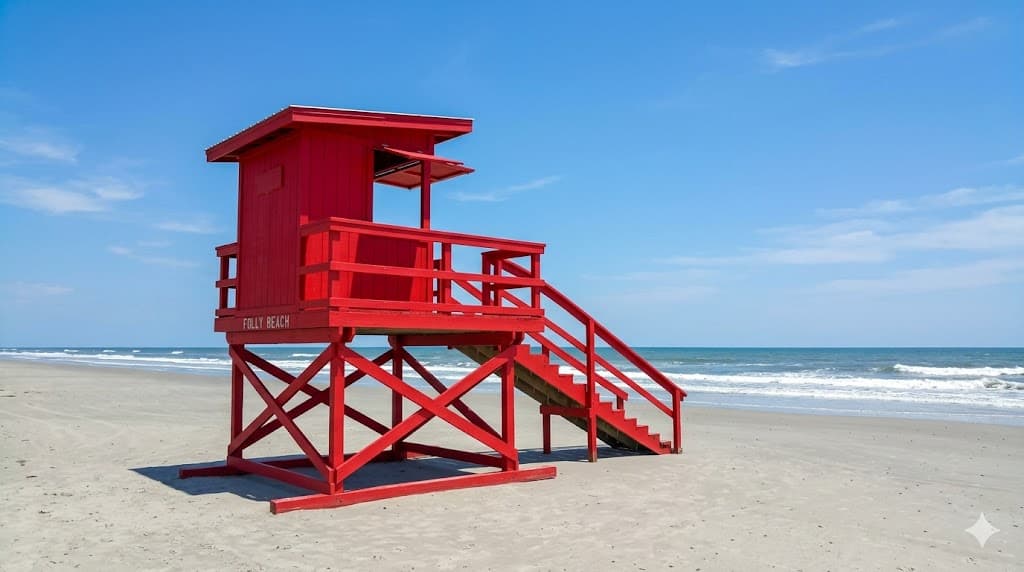
Folly Beach has lifeguard coverage during peak season. Knowing where guards are stationed, when they're on duty, and what the flag system means is basic beach safety information that every visitor should have before entering the water. Here's what you need to know.
Lifeguard Coverage — When and Where
The City of Folly Beach provides lifeguard coverage at the main beach access points during peak season. Coverage is concentrated near the primary accesses around Center Street and the pier area — the sections of beach that receive the highest visitor volume.
Peak season coverage typically runs Memorial Day weekend through Labor Day, with daily staffing during those months. Hours generally run from mid-morning through late afternoon, though exact times vary and are subject to change.
Off-season: Lifeguard coverage is reduced or eliminated outside of peak season. If you're visiting Folly Beach in April, October, or any shoulder or winter month, assume there are no lifeguards on duty and swim accordingly.
Folly Beach County Park operates its own separate lifeguard program managed by Charleston County Parks and Recreation. Coverage schedules at the county park may differ from city beach coverage — check the Charleston County Parks website for current county park staffing.
Always verify current coverage times through the City of Folly Beach's official channels before your visit. Schedules adjust seasonally and can change based on staffing availability.
The Flag System
Folly Beach uses a colored flag system to communicate current water conditions at staffed beach access points. Understanding what each flag means can prevent a dangerous situation.
Green flag: Low hazard. Calm conditions. Safe for most swimmers.
Yellow flag: Medium hazard. Moderate surf or currents present. Swim with caution. Children and weak swimmers should stay in shallow water.
Red flag: High hazard. Strong surf, currents, or dangerous conditions. Swimming is strongly discouraged. If two red flags are flying, the beach is closed to swimming entirely.
Purple flag: Marine life hazard. Jellyfish, stinging creatures, or other marine life present in the water.
Check the flags at the nearest lifeguard stand before entering the water. Conditions can change quickly on Folly Beach — a green flag morning can become a yellow flag afternoon as wind and swell develop.
Rip Currents
Rip currents are the primary water hazard at Folly Beach. A rip current is a narrow, fast-moving channel of water flowing away from the beach and out to sea. They form at breaks in sandbars, near the pier, and at other points where water concentrates as it returns to sea after waves push it ashore.
How to identify a rip current: Look for a channel of choppy, discolored water extending beyond the surf line. The water in a rip current often has a different color from surrounding water and may appear to be foaming or churned.
What to do if caught in a rip current: Do not swim directly against it toward shore — this exhausts most swimmers. Swim parallel to the beach until you're out of the current channel, then swim back to shore at an angle. If you can't escape, float and signal for help rather than fighting the current.
Where rip currents form on Folly Beach: Near the pier is a common formation point — water funnels along the pier structure and returns to sea at the end. Any break in the sandbar can produce a rip current. After storms when sandbars are reshaped, new rip current locations can appear.
Surfing in Relation to the Swimming Zone
During lifeguard-staffed hours, surfing is prohibited within the designated swimming zone adjacent to lifeguard stands. The boundaries of the swimming zone are marked at the beach.
Surfing is also prohibited within 300 feet of the Edwin S. Taylor Fishing Pier at all times, regardless of lifeguard coverage. This is a year-round rule.
These restrictions exist to prevent collisions between surfers and swimmers in shared water. They are enforced. For the complete picture of beach rules including surfing zones, see our full Folly Beach rules guide.
Beach Safety Basics
A few fundamentals that apply regardless of lifeguard coverage:
Never swim alone. This is basic water safety that applies everywhere.
Know your limits. The Atlantic Ocean at Folly Beach is not a pool. Currents, waves, and changing conditions require swimming ability beyond the basics.
Watch children constantly. The surf zone moves fast and children can be swept off their feet by waves in shallow water. Constant supervision is essential.
Swim near a lifeguard stand when possible. When guards are on duty, staying in their direct line of sight gives you the fastest possible response if something goes wrong.
Respect the flags. The flag system exists because conditions genuinely vary and the hazards are real. A red flag day is not a suggestion.
For more on planning a safe visit, see our complete guide to Folly Beach rules and the Folly Beach surfing guide if you're planning to get in the water with a board.