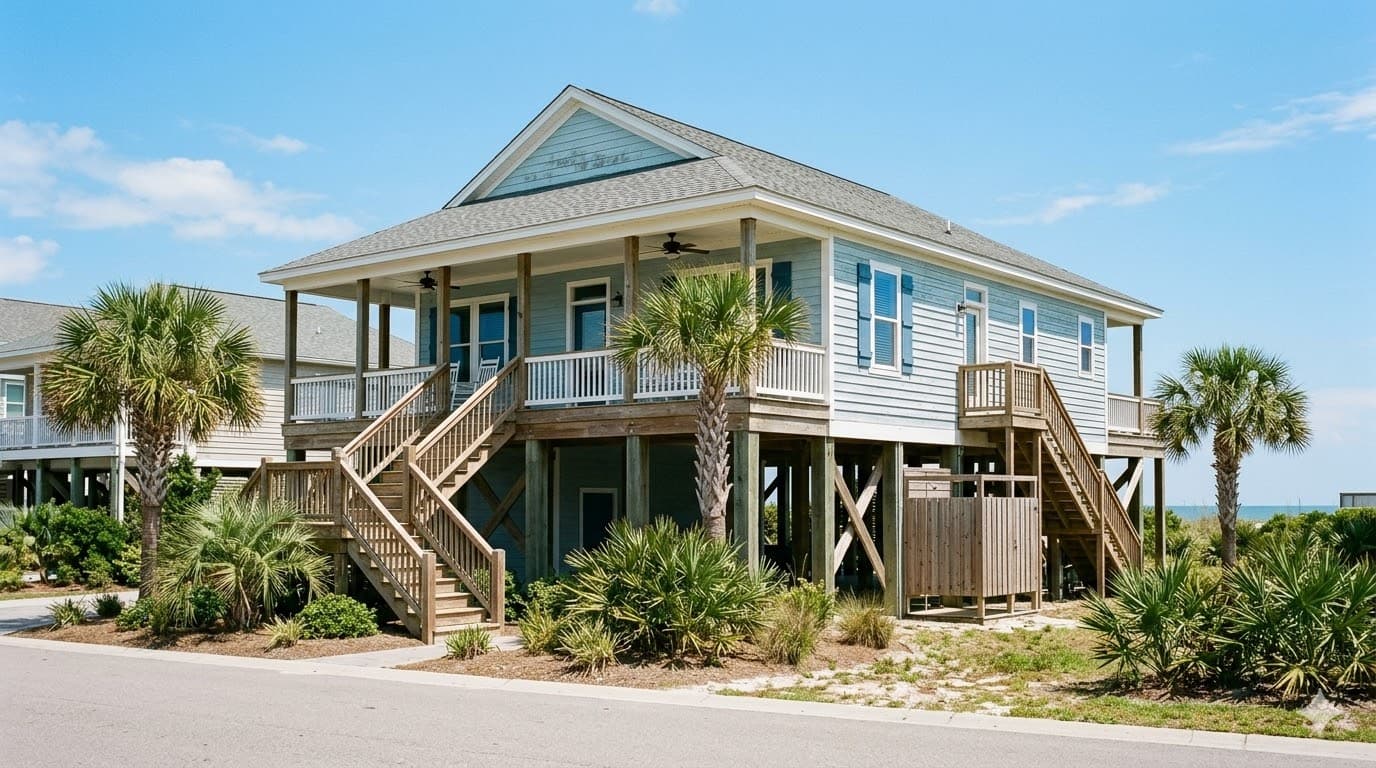
Folly Beach has roughly 2,400 permanent residents and somewhere north of 800 short-term rental licenses. On a busy summer weekend, the island's population swells to 20,000 people. That math tells you something important: renting on Folly Beach is the primary way most people experience it, and the rental market here is serious business.
This is the complete guide to vacation rentals on Folly Beach, SC — what to expect, where to stay, how to book, and what the locals know that the listing photos don't show you.
Why Folly Beach Is Different From Other SC Beaches
Folly Beach is not Hilton Head. It is not Myrtle Beach. It is not Isle of Palms. Those places have their merits, but they are resort beaches — manicured, commercial, and built around the hospitality industry.
Folly is a barrier island with a bohemian soul. The houses are colorful, often quirky, built on stilts to meet flood code, and packed close together on narrow streets that run perpendicular to Center Street. The rental stock reflects that character. You're not booking a resort room. You're booking someone's beach house — complete with an outdoor shower, a screened porch, bikes in the carport, and a lockbox on the front door.
That's a feature, not a bug.
Understanding the Rental Market
The city of Folly Beach implemented a short-term rental cap in recent years — limiting the total number of investment STR licenses to around 800. This cap has two practical effects: inventory is constrained, and prices reflect that constraint.
What this means for renters: book early. Summer weekends on Folly Beach fill up months in advance. If you're planning a summer trip and want a specific property in a specific location, booking in January or February for a June or July stay is not excessive — it's realistic.
The shoulder seasons — May and September through October — offer better availability and meaningfully lower rates, often 20 to 30 percent below peak summer pricing. The water is still warm in September. The crowds are thinner. Locals consider the shoulder season the best time to visit.
Where to Stay on Folly Beach
Ocean side vs. river side is the first decision. Folly Beach sits between the Atlantic Ocean and the Folly River, and rentals on each side have a different feel.
Ocean side — direct beach access, higher prices, more noise on weekends. If getting to the sand fast in the morning is your priority, ocean side is worth the premium. Properties directly oceanfront are the most expensive on the island.
River side — calmer, quieter, often better value. You're a short walk from the beach but you get marsh views, stunning sunsets over the Folly River, and a more peaceful atmosphere. River-side rentals are often the better deal for families who don't need to be steps from the sand.
Near Center Street — if you want to walk to restaurants and bars, staying within a few blocks of Center Street puts everything on foot. That walkability is the same whether you're visiting for a day or staying for a week. The tradeoff is noise on Friday and Saturday nights.
The west end — near the Washout and Folly Beach County Park, the west end is more residential and quieter. Better for surfers who want to be near the best break, and for families who want a slower pace.
What to Look for in a Listing
Folly Beach rental properties vary significantly in quality. Here's what to actually look for beyond the photos:
Elevation and flood zone. All of Folly Beach is in a FEMA flood zone. Properties vary in how well they handle heavy rain and storm surge. Look for listings that specify the elevation certificate and mention the house being elevated on pilings. Ground-floor square footage on Folly is often just storage and parking — the living space is upstairs.
Air conditioning. Summers on Folly Beach are hot and humid. Every rental should have central AC. Verify this before booking — some older properties have window units that struggle in July.
Parking. Most rentals include one or two parking spaces under the house. If you're coming with multiple vehicles, confirm parking availability. Street parking near popular beach accesses is competitive.
Outdoor shower. A minor thing that matters. Coming back from the beach covered in sand and salt without an outdoor shower is an experience you only want once. Most Folly rentals have them — verify yours does.
Beach access. Public beach accesses are located throughout the island, typically at the end of each lettered avenue running perpendicular to Center Street. Your rental doesn't need to be oceanfront to have easy beach access — most properties are within a two to five minute walk.
Where to Book
VRBO and Airbnb are the primary platforms for Folly Beach vacation rentals and have the broadest inventory. Both platforms give you guest reviews, verified photos, and cancellation policy details upfront. For Folly Beach specifically, VRBO tends to have more family-oriented houses while Airbnb skews toward smaller properties and guest rooms.
Dunes Properties is the local property management company on Folly Beach. They manage a large inventory of houses and condos directly, and booking through them often means better local support if something goes wrong during your stay. Their website lists properties with detailed information including flood zone and elevation data — more than most third-party platforms provide.
Direct booking — some Folly Beach homeowners manage their rentals independently. If you find a property you love, look for a direct website. Booking direct often saves you platform fees, which can be significant on a multi-night stay.
What a Realistic Budget Looks Like
Prices vary significantly by season, property size, and location. As a rough guide for 2026:
Off-season (October through April): A two-bedroom house runs $150 to $250 per night. Three-bedroom houses start around $200 per night. Oceanfront properties command a 30 to 50 percent premium over comparable non-oceanfront rentals.
Peak season (Memorial Day through Labor Day): Expect $300 to $500 per night for a two-bedroom house. Three and four-bedroom houses for families run $400 to $800 per night. Oceanfront properties in this range push well over $1,000 per night during Fourth of July week.
Minimum stays apply at most properties — typically two nights off-season and three to seven nights during summer. A full week booking in summer often yields better per-night rates than a three-night minimum.
The STR Cap and What It Means for Visitors
Folly Beach's short-term rental cap means the inventory of legally operating vacation rentals is finite and stable. You won't see the kind of endless new supply that platforms like Airbnb have generated in some markets. If you're weighing a longer-term commitment to the island, what it's actually like to live on Folly Beach full-time is worth understanding before you decide.
The practical effect: if you find a property you love, bookmark it and consider returning to the same place. Repeat guests who book the same property year over year get first-come access from homeowners who prefer known guests. Building a relationship with a Folly Beach rental — or a local property manager — pays off over time.
Final Advice
Book early for summer. Consider the shoulder seasons seriously — you'll pay less, crowd less, and see more of what Folly Beach actually is when the tourist volume drops. Choose the river side if you want sunsets and value. Choose the ocean side if proximity to the water is non-negotiable.
And when you get there: leave the car keys alone. Folly Beach is walkable, bikeable, and better experienced on foot. Rent a bike from one of the shops on Center Street and spend your first morning riding from one end of the island to the other. It takes about twenty minutes. You'll understand the island better from that ride than from any amount of research. The complete guide to things to do on Folly Beach covers everything worth doing once you've settled in.